Sunday, March 30, 2014

Don't Change on me Twitter

As a major proponent of Twitter, I tend to ignore when people suggest that the social network is phasing out.  Since I first created my account, I have always kept up-to-date on my news feed and never hesitate to create a post when I have an interesting thought or share-worthy experience.  One of the things that keeps me going back to Twitter is that, in general, it hasn't really changed.


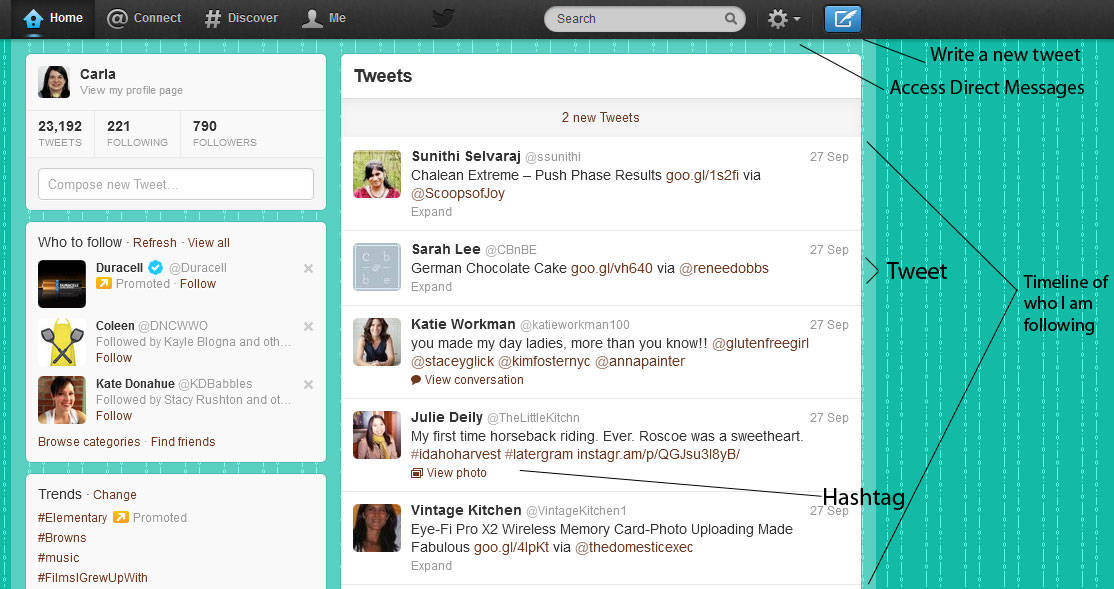
The concept has remained simple- 140 characters to encourage likes or retweets from fellow tweeters.  The interface has barely changed- a scrollable newsfeed organized by the time of posting.  And its main features reflect the same ones of the past- the tag and the hashtag.

Lately though, Twitter has started to push the edges of change with new developments within the platform.  A fellow classmate, Katherine, shared the new feature of Twitter that allows you to post up to four photos in a tweet and tag up to ten friends, without using up any of the precious 140 characters. 


Another classmate lead a discussion that focused on the elimination of tagging other users in posts, making Twitter more of a dialogue between users.  And yet another article that I found suggests the extinction of the hashtag.  

While some, like Katherine and Katie, think that these new additions will ultimately increase Twitter's popularity, I think that they will take away from what makes Twitter.. Twitter.  

Twitter is a forum for sharing and consuming a variety of thoughts and updates.  I enjoy reading through my timeline and seeing a mix of information and ideas.  I like not just being able to find out what my friends are doing, but being able to read news updates, live sports commentary, clever ideas and jokes, and current trends.  What makes Twitter enjoyable for me is the variety that it brings.

With the new features of Twitter, I think it will begin to lose this variety that distinguishes it from other social media.  Twitter is not a primary photo-sharing forum, so I don't see the necessity for the photo-tagging feature.  Twitter is not a messaging application, so I don't see the necessity of removing the "@" symbol.  And Twitter is not an independent sharing source, so I don't see how the lack of a hashtag would be plausible in a network that constantly connects others with others, others with ideas, and ideas with ideas.

Twitter does allow photo-sharing and dialogue between users, but its main focus is for users to share their thoughts, read others ideas, and connect and interact with users. I do not see the "@" symbol or hashtag going anywhere any time soon because of their abilities to create this interaction.  And I also hope that encouraging users to share more photos won't turn it into the next Instagram.

In a social media world that is becoming more heavily centered on pictures, with apps like Instagram and SnapChat,  I think Twitter holds its value in its 140 characters.  Its where I turn to actively read and engage, instead of just scroll through photos.  

Unlike a picture, words allow each viewer to see something different.  A picture may be worth a thousand words, but a word may be worth a thousand pictures. And 140 characters could make many words...


Are you Being Tracked?


Recently, I wrote a post about my opinion on the ability of users to track their emails.  I think that allowing senders to essentially put a "read receipt" on emails that they have sent- without the receiver's knowledge- crosses boundaries of personal privacy.

After reading the original post, you could imagine my response when I stumbled across an application that allows you to track emails on your iPhone- "Mailtracker." Mailtracker works through the iPhone mail app and informs users of when their email has been read, where it was opened, how many times it was opened, how long it was viewed, and what type of device was used to read it.

So.. basically my worst email nightmare.  Not only does it disagree with my personal opinion of email privacy, but it infringes on other aspects of privacy, like location.  Personally, I don't want others to be able to identify exactly where I am, simply because I opened their e-mail.

However, there are instances when being able to determine a receivers location can be helpful.  For example. the original idea for the application stemmed from a scam that the co-founder avoided by identifying the location of the receiver of one of his email messages.  While I see the usefulness of a tool like Mailtracker in cases like this,  I think its creepiness outweighs its benefits.  

To divert attention away from this creepiness, Mailtracker markets towards the sender, not the receiver.  It employs the slogan "stop guessing, start knowing," which seems convincing- even to me. But it fails to address the receiver of an email from a Mailtracker user. 


I would love to know if my professor, who never responded to my email, had actually even opened it.  It would would be awesome to be able to tell if my resume had been viewed by a potential employer and for how long they had looked at it.  I would definitely prefer to have this knowledge instead of always wondering, but not at the expense of my own privacy.

If Mailtracker became a common tool, I would surely start to leave e-mails sitting in my inbox for extended periods of time.  I would have to wait until I was at an appropriate place and time to open them, and I would most likely feel obligated to respond immediately.  Not only would this be annoying for me, but because I'm constantly on the go, it would be extremely inconvenient.

Some may argue that this is just the next obvious step following the read receipt on iMessage.  The read receipt already allows you to see if others have viewed your message. But Mailtracker is not the next step, it is a major leap.  It taps into the location and engagement of the receiver, without letting them decide if they want the sender to know any of this information about them.  

Read receipt is okay, because you get to decide if others can know whether you have read their message or not. Mailtracker leaves the receiver with no control, while crossing new lines of individual privacy.


To learn more about MailTracker read this article that I found: http://techcrunch.com/2014/03/28/mailtracker-for-ios-brings-read-receipt-functionality-to-apples-default-mail-application/?ncid=rss

Singing in the Rain


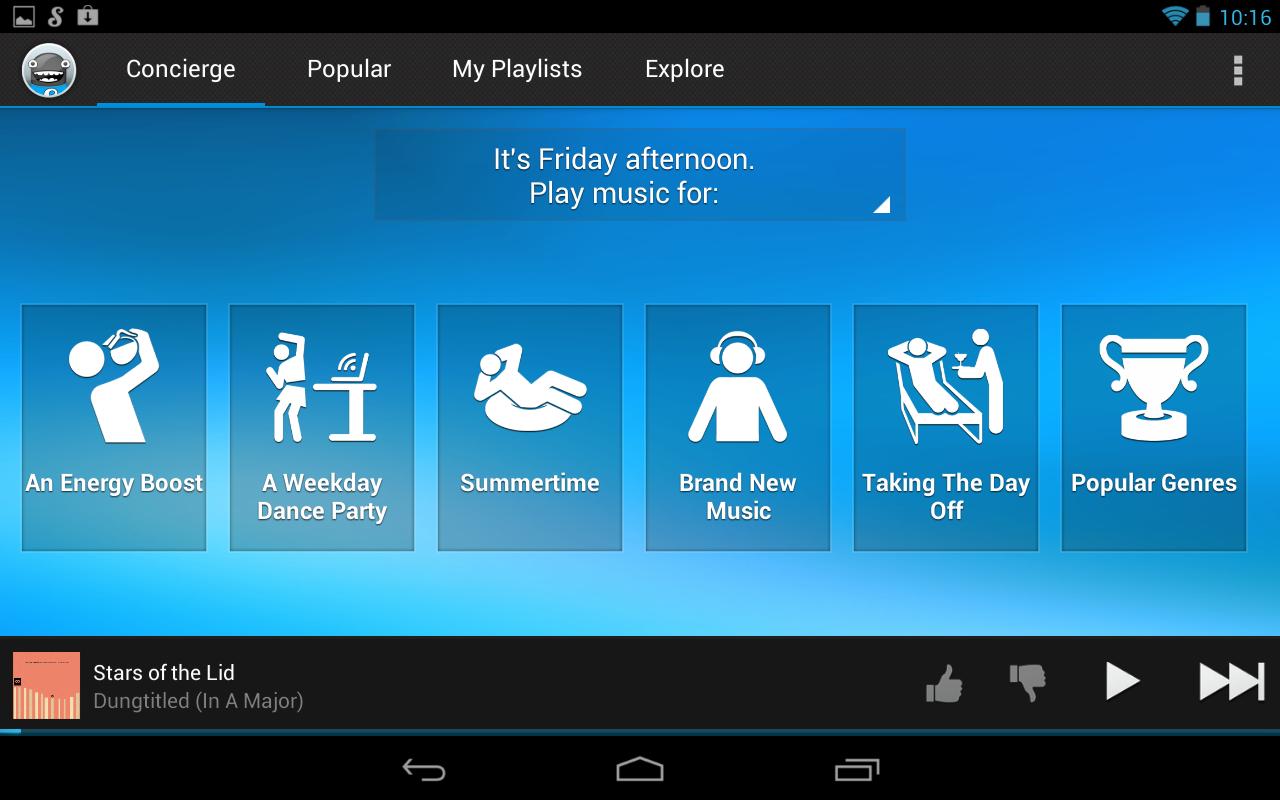
I have always been a frequent user of music apps that allow you to listen to playlists based on your current mood.  While others frequently turn to pandora or spotify, I visit services like 8tracks and Songza.  On both applications, I can select one or two words that describe how I'm feeling or the type of music that I am in the mood for, and it will direct me to a list of playlists that match my selections.


These types of music-listening tools are good for people who want to let others make their music decisions for them.  I have trouble deciding what specific songs I want to listen to, so I leave it up to Songza.  

Technology is getting closer and closer to being able to decide exactly what we want.  Eventually, it will know what we want before we know ourselves.  Songza took one step closer to this knowledge when it joined with the Weather Channel to coordinate weather conditions with music choices. 

This is genius for Songza, because two significant indicators of mood are music and weather.  Songza is combining the two to create a new level of listening experiences based upon mood.  And for people, like me, who don't like to make decisions for themselves, it's perfect!

Personally, I almost always alter my music preferences based on the weather.  When it's raining and miserable out, you'll most likely find me listening to calm acoustic or blaring some heartbreaking Adele.  When the first beautiful and warm day of late spring arrives (still waiting this year), I immediately hop in my car, roll the windows down, and cruise to upbeat anthems of summer.  

But imagine if these songs were determined for me, before I even had a chance to check the weather. I could get in my car, turn on Songza and have the music that I want to listen to ready to be played.  

Songza's new feature allows you to choose a playlist based on the weather.  For example, a thunderstorm may offer potential mood selections of "relaxing and soothing," "anxious and nervous," or "angry and brooding." In addition, the addition of weather-based choices will allow Songza to identify certain changes in a user's routine or mood with changes in weather- consequently, furthering their ability to offer suggestions that predict your mood more accurately in the future.

Some might argue against allowing technology to decide your mood for you.  I agree that this ultimately could cross boundaries and potentially limit our preferences. But.. if you know that the weather usually affects your mood anyways, why not utilize a convenience service that delivers music to match your preferences.  

I know that I will.  


Tuesday, March 25, 2014

Controlling the Experience

Everyone loves a good SnapChat- whether its receiving one or creating one.  This small flash of a selfie, digital finger-painting, or event allows us to share with others in a way much different than most of social media today.


But why is SnapChat so popular?

Tara attributes its success to the fact that it is a forum without judgement. She says that "it doesn't matter what your friend thought of that last really ugly face you pulled- it's gone by now, and your friend has probably already forgotten about it, too."  Unlike platforms like Facebook and Twitter, Snapchat doesn't provide a set mechanism for supporting, disapproving, or disregarding something that a social media peer has shared.

While I do agree that it is easier to share on SnapChat, without the anxiety of not receiving an appropriate amount of "likes," I do not necessarily think that judgement within its network is completely inexistent.  For instance, others may give you direct feedback by responding to your snap or indirect feedback by snapshotting or simply opening it.

SnapChat isn't judgement-free, its just judgement in a more private setting- away from other onlookers and "friends." Only you can see the feedback from those who you choose to share something with.

But there has to be more than just the fear of being judged that keeps us snapping all day.

In addition to being able to hide feedback from others, I think that a major factor of SnapChat's popularity is the higher level of control that users have over their experience. Ultimately we get to control the content that we post on any social sharing tool, but SnapChat allows us to control exactly who gets to see this content and for how long they get to see it.


Although these are only two small differences to other social media networks, they create the illusion of an experience that is completely controlled by the sender.  The lack of public approval or disapproval on SnapChat, that I discussed earlier, lends a hand to this control.  We get to choose how we want to present ourselves, without letting social media and other peers on social media determine it for us.

It is also important to take into consideration the popularity of specifically viewing SnapChats.  I had to dig deeper than my own personal experiences to see what makes viewing SnapChats more enjoyable than just passively scrolling through my Instagram feed.

And once again, I believe that it circles back to control and choice.  When we receive a SnapChat, we have to actively choose to open it, in order to view it.  We get to choose if and when we do this.  And what Danah Boyd, of Microsoft Research, suggests is that "when people do choose to open a Snap, they actually stop what they're doing and look."

This claim is true, at least for my personal use.  Whenever I receive a SnapChat, I often wait until I am in the right place and time to open it. That way, I can focus on it and interact  accordingly.

SnapChat offers no option of passivity like the norms of most social media.  We must choose, and therefore, we tend to focus.  Boyd points to this attention and more-personal feel of SnapChat as setting the app apart from other social networks- "Snapchat asks you to stand still and pay attention to the gift that someone in your network just gave you."


Sunday, March 23, 2014

Maybe it's Called a Newsfeed for a Reason


Wasting my day away in a small study room on the barren seventh floor of the Davis Library, I was abruptly jolted from my focus by the sound of a less-than-confident voice on the intercom.  He was informing my fellow library-goers and me that the library was on "lockdown" and that no one was to leave the building.  I'm not proud of it, but I usually don't take the constant bombardment of 'Alert Carolinas' very seriously, but this time, something was different.

I immediately flash backed to the episode of Grey's Anatomy that I had watched last night.  The episode was about a gunman roaming the halls of the hospital, taking down any surgeon that got in his way.  Although a fictional series, I was shocked at the hospital's emergency plan- putting the building on lockdown, without patients or staff members fully aware of what was happening.  How could such a large entity allow one man to cause so much damage without a ready plan to stop him?


And there I was...  In this massive library, on a fairly-large campus, with thousands of students...  My only thought was that the same gunman would be knocking on my door in a matter of minutes.  Completely frightened, with my thoughts stuck on the recent tv episode, I initially felt confused and alone.  And then I remembered that I owned a cell phone.

While my first instinct should've been to check 'Alert Carolina' for an update, it sadly wasn't.  I pulled up my twitter newsfeed, which informed me of the situation with ease.  My feed was flooded with first-hand stories of the account, retweets from various chapel hill sources, cries from peers to remain inside, and prayers of safety.  

It wasn't until about four minutes had elapsed that I actually received an official update from Alert Carolina, confirming many of the tweeters' claims.  Apparently, others had similar experiences.  John blogged about his own disappointment with the long-response time of Alert Carolina.  He says, "The news traveled more quickly, and more effectively through a massive social networking site, and not an official first-rate University of North Carolina - approved system of communicating."


He asks why the school's system is much worse at offering adequate information to its students than the students themselves.  What does this mean for UNC's ability to protect its students and staff?  

Regardless of the implications of the shortfall of Alert Carolina, I think our personal stories in the crisis serve as a testament for the changing face of news and how we consume it.  News is and will continue to be crowdsourced to everyone who contributes to social networks and thought-sharing forums.  It was easier for me to simply click on my twitter icon than to search for a potential update from the school system.  And the fact that I completely trusted that I would be able to find news about the shutdown on a social media network speaks for itself.  

It wasn't until I got the full update from twitter and Facebook that I turned to Alert Carolina to verify the information that I had found.  As this article from The Economist suggests, "news organizations need to recognize that journalism is now just part of a conversation that is going on anyway."  News has become a conversation amongst individuals across different mediums. Legitimate news orgs and entities- like Alert Carolina- are becoming more and more of a source for fact-checking.


The event from today, along with fellow students' insights, made me think a lot about what crowdsourcing means for the future of news.  If our twitter feed is where we get our updates, what does that mean for the survival of major news organizations? It's time to do some research..


Friday, March 21, 2014

The Social Media Exception


When I think of effective marketing today, my thoughts immediately turn to social media.  I think of companies who have introduced new products, services, and promotions through social networks, like Twitter, Instagram, Facebook, etc.  It seems like every established company has some form of a social media campaign that they use to reach and interact with their customer base.

We've all seen the sponsored advertisements on our twitter timeline, and even perhaps mentioned a company in one of our tweets in hopes of producing a response or compensation for a complaint that we have about their product.  One time, I even just cited Chobani in one of my tweets as being the "satan of Greek yogurts," without actually tagging the franchise, and they informed me that they were happy that "at least I got my protein punch." - my fifteen minutes of twitter fame, that left me more angry than excited.

Without a doubt, social media has become a significant tool for businesses of all varieties.  In order to keep up in modern consumer society, businesses must recognize social media as an integral part of any marketing strategy.  

But after discovering a problem with my Mac computer and visiting the Apple twitter page out of curiosity, I was shocked to find the twitter account barren, with zero tweets.  After a single Google search, I found  that Apple doesn't really engage with any social media at all.  Yet, they somehow maintain a $98 million brand.


How in the world do they do this? And Why?

This article suggests that their lack of social media presence is a reflection of the company's secretiveness.  It suggests that, both inside and outside of the corporate atmosphere, Apple bars others from knowing about upcoming innovations.  The secret-nature of the company breeds anticipation from both consumers and competitors. Apple is allowed to be "anti-social," simply because they "can afford to be."

I agree that anticipation boosts the excitement of consumers and may contribute to Apple's overall success, but I think there has to be a larger reason behind why Apple abstains from participating in the world of social media.  Perhaps its because using resources on social media would be a waste, or perhaps its because, as this other commentary claims, they fear not being able to control their message.

Apple's Brandwatch CEO, Giles Palmer, argues that "Apple's non-relationship with social media comes down to not being able to control the environment."  In their stores and their personal websites, they have control over virtually everything- their staircases even have a patent.  But social platforms are "run by the crowd.  It's uncontrolled and unpredictable and that's why many of us love it.  but Apple-land is not, so they don't play."

Seeing Apple as a control-freak helps me to better understand why they would choose to not develop a social media presence.  They already are a well-known, successful, and powerful company, and it seems logical that they would want to maintain their loyal customer base on their own terms.  They want to create their image and reputation from the inside, rather than letting social media try to determine it for them.

However.. How long will Apple's safe and smart mentality continue to work in a society where risk is rampant and social media rules? My guess is that they'll be forced to take steps towards social media action in the very near future.


Tuesday, March 18, 2014

The Anonymity Advantage


A popular topic of conversation has been over the negative effects of anonymity online.  It is impossible to deny the downfall of applications like Yik Yak and Secret that allow for anonymous posters.  I think that the main detriment of the apps results from a poster's ability to avoid accountability.  Whenever posters are not held accountable for their comments or thoughts, most of what they share can easily be either untrue or hateful towards others.

Is it right to be able to say something online without an identity that you would have never said otherwise?  Is it right to intentionally bully others without them knowing who initiated the deed?  

Although not a frequent user, I have Yik Yak on my phone for spurts of boredom when I feel like reading something humorous.  While I do find some posts hilarious, the overall majority of them are simply mean.  The most hurtful and alarming posts are those that target specific individuals, and I think that mechanisms for anonymous commentary directly feed into the cyberbullying that people constantly work so hard to oppose.

But if these applications have so many unfavorable characteristics, then why are they popping up everywhere.  Many of us have argued that people simply like the thrill of getting to share their thoughts and rants, without others knowing who they are.  Others believe, like me, that a large contributor to their success is the humor factor.  

With so many nasty outcomes though, I believe that anonymity online must have a bigger advantage. It can't just be making people laugh with perhaps inappropriate commentary that wouldn't have necessarily been shared in a forum with identity policies.

When you think past the bullying and the pointless postings, it is easier to see that anonymity allows more than just self-expression of jokes or stabs at other individuals.  It allows for self-expression of revolutionary ideas.  It allows for controversial arguments that ignite conversation and thought, that otherwise would have been simply kept under wraps.

After deeper examination, I found this New York times article that helped to reinforce my claim.  
It drives home the point that destroying anonymous platforms could ultimately destroy unconventional actions online.  


It articulates my thoughts on the advantages of anonymity perfectly, but I disagree with the article on a concept that it calls "traceable anonymity."  It suggests that anonymity that harms other people should be traced to reveal the original poster's identity.  While this would be ideal, it does not seem plausible.  

I believe that to benefit from the advantages of anonymity, we must learn to deal with the disadvantages that come along with them.  To help reduce the malicious side effects of anonymity online, we need to encourage others to refrain from posting erroneous information and from harassing others in these anonymous forums.  Anonymity could be positive if we all stop supporting the negative.  We're all guilty- even me!